“I don’t remember phone numbers anymore.” “I ask AI before making a decision.” “I use AI to organise my thoughts.”
If any of this sounds familiar, you’re not alone. AI has become a part of our everyday life. People use it to write emails, plan holidays, prepare for interviews, make sense of difficult emotions, and even work through personal problems. It saves us time and effort.
But it also raises an interesting question: if AI is doing more of our thinking for us, what is that doing to our own minds?
Psychology doesn’t treat this as something to panic about. Instead, it encourages us to simply understand what’s happening.
We’re wired to save mental effort
Our brains naturally look for ways to conserve energy. That’s why we build habits, set reminders, write shopping lists, or save contacts in our phones instead of memorising them. Psychologists call this cognitive offloading, a term that simply means using tools outside our own heads to help us remember or think things through (Risko & Gilbert, 2016).
AI is just the newest version of this. Instead of digging through dozens of websites or spending hours untangling our thoughts, we can now ask AI directly. It can explain ideas, summarise information, or even help us put feelings into words.
If used well, this can genuinely help. If AI saves you time on a routine email, you have more energy left for the work that actually needs your full attention. In this sense, AI supports our thinking and it doesn’t replace it.
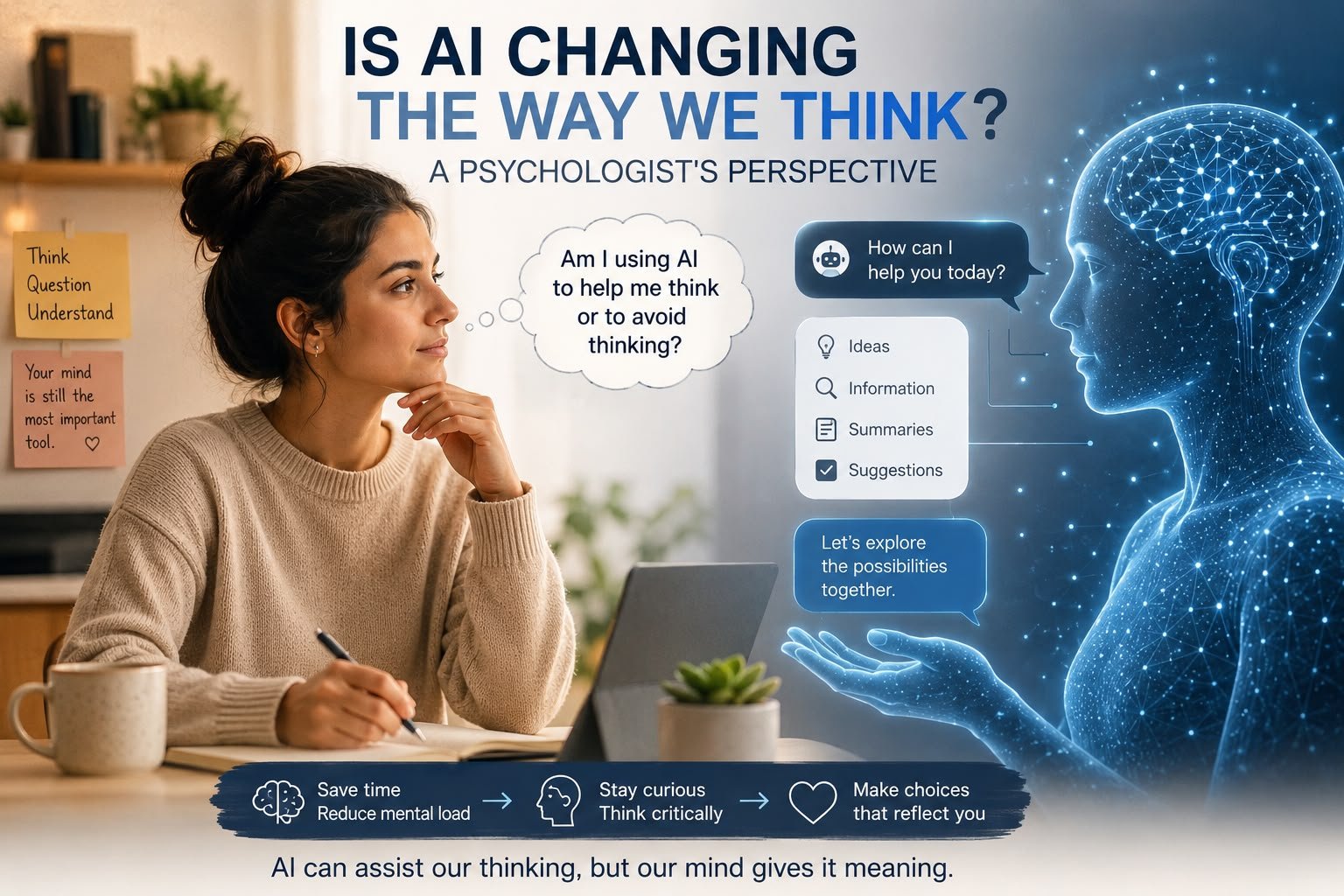
At the same time, it’s worth pausing to ask: Am I using AI to help me think, or to avoid thinking altogether? There’s a real difference between the two.
Asking AI for ideas to kick-start a presentation is using it as a starting point. But if you copy everything it gives you without questioning it or adding your own perspective, you may gradually stop practising skills like problem-solving and decision-making, skills that only get stronger with use.
Research backs this up. One study found that when people know information is saved online somewhere, they’re less likely to remember the information itself they just remember where to go looking for it (Sparrow et al., 2011). This doesn’t mean our memory is getting worse. It means our brains are adjusting to a world where information is always within reach.
The same pattern may apply to AI
If we ask AI to answer every question, solve every problem, or make every decision for us, we may slowly lose confidence in our own judgement. This matters most with personal decisions. AI can help you weigh up different options or organise scattered thoughts. But it doesn’t know your life, your relationships, your values, or the experiences that shaped who you are. Two people can ask AI the exact same question and still need completely different answers. Some decisions still need something only you can bring to the table: your own sense of what matters to you.
So, AI is a powerful assistant but it shouldn’t become the only voice we listen to. The future probably isn’t about choosing between human thinking and artificial intelligence. It’s about learning to use both well. AI can make thinking easier. But qualities like curiosity, sound judgement, creativity, and self-awareness still come from pausing, asking questions, getting things wrong sometimes, and working through problems ourselves. Technology can hand us answers. Making sense of them is a part that is still ours to do.